Why the Zebra DS4608 Is Redefining Retail Scanning Standards
Retail technology moves fast. Self-checkout, contactless payments, and digital loyalty programmes have all shifted expectations around speed and versatility at the point of sale. Yet the humble barcode scanner — the device that makes every transaction possible — is often the last piece of hardware to receive serious attention during a POS refresh.That oversight is becoming harder to justify. As QR codes, GS1 DataMatrix labels, and mobile wallet barcodes proliferate alongside traditional 1D product codes, the gap between a capable scanner and an inadequate one widens with every season.
The Zebra DS4608 Barcode Scanner was built precisely to close that gap — delivering enterprise-class versatility in a format suited to everyday counter use.This article examines why the DS4608 is raising the bar for what retailers should expect from a scanning solution, how it handles the real-world demands of modern POS environments, and what to consider when evaluating it for your operation.
The Problem with Yesterday's Scanners
A generation ago, barcode scanning was a solved problem. Every product carried a 1D UPC or EAN label. The scanner read it. The till rang it up. Done.The modern POS environment is considerably more complex. Consider what a typical retail scanner now encounters in a single shift:
- 1D barcodes on product packaging (UPC-A, EAN-13, Code 128)
- 2D QR codes on mobile loyalty apps and digital receipts
- GS1 DataMatrix codes on pharmaceutical and healthcare products encoding lot, batch, and expiry data
- PDF417 codes on government-issued IDs for age-restricted purchases
- Aztec codes on transit tickets and event passes
- Poorly printed or damaged labels on returns and second-hand goods
An entry-level 1D scanner fails every 2D scenario. A mid-range scanner without centralised management creates headaches for IT teams across multi-site operations. And a device without proven durability becomes an ongoing replacement cost rather than a capital investment.
Introducing the Zebra DS4608: Built for What Retail Demands Now
The Zebra DS4608 Scanner addresses every friction point above in a single, counter-ready device. It is a corded handheld scanner with an omnidirectional imaging engine, designed to decode 1D and 2D symbologies at the speed a busy checkout requires.Rather than listing features in isolation, it helps to understand how the DS4608's design choices translate into tangible operational benefits.
Omnidirectional Reading Reduces Transaction Time
Traditional scanners require the barcode to pass through a narrow read zone at the right angle. Cashiers adapt — consciously or not — by rotating items, repositioning packages, and occasionally waving items back and forth until the scanner triggers. Each of these micro-corrections adds time. Across hundreds of transactions per day, those seconds are significant.The Zebra DS4608 1D/2D Scanner uses an area imaging engine that reads codes from any orientation. Items move past the window at natural speed and angle. Staff are not trained to accommodate the scanner — the scanner accommodates them.
Dual Interface Connectivity Protects Existing Hardware Investment
The Zebra DS4608 Barcode Scanner USB RS232 configuration is one of its most commercially practical features. Many retailers operate mixed hardware environments — modern USB-based POS terminals alongside older RS232 serial equipment that remains fully functional and is not due for replacement. The DS4608's support for both interfaces means organisations can standardise on a single scanner model across the estate without forcing a parallel hardware refresh. When older terminals are eventually retired, the scanners remain compatible with their replacements.
Enterprise Durability Without Enterprise Complexity
The DS4608 carries an IP52 ingress protection rating and is tested to withstand drops from 1.5 metres onto concrete. This is not a device engineered for a climate-controlled demo environment — it is rated for the daily reality of retail floors, where scanners get knocked off counters, splashed with liquids, and handled by dozens of different staff members per shift.
Zebra DNA: Centralised Control Across Your Scanner Fleet
For multi-site retailers and healthcare networks, the Zebra DNA management suite transforms the DS4608 from a standalone peripheral into a managed asset. IT teams can push firmware updates, standardise symbology configurations, monitor device health, and troubleshoot remotely — without dispatching engineers to individual locations. This capability, standard in enterprise wireless infrastructure, is relatively rare at this price point in the scanner market.
Product Spotlight: DS4608 Scanner Specifications at a Glance
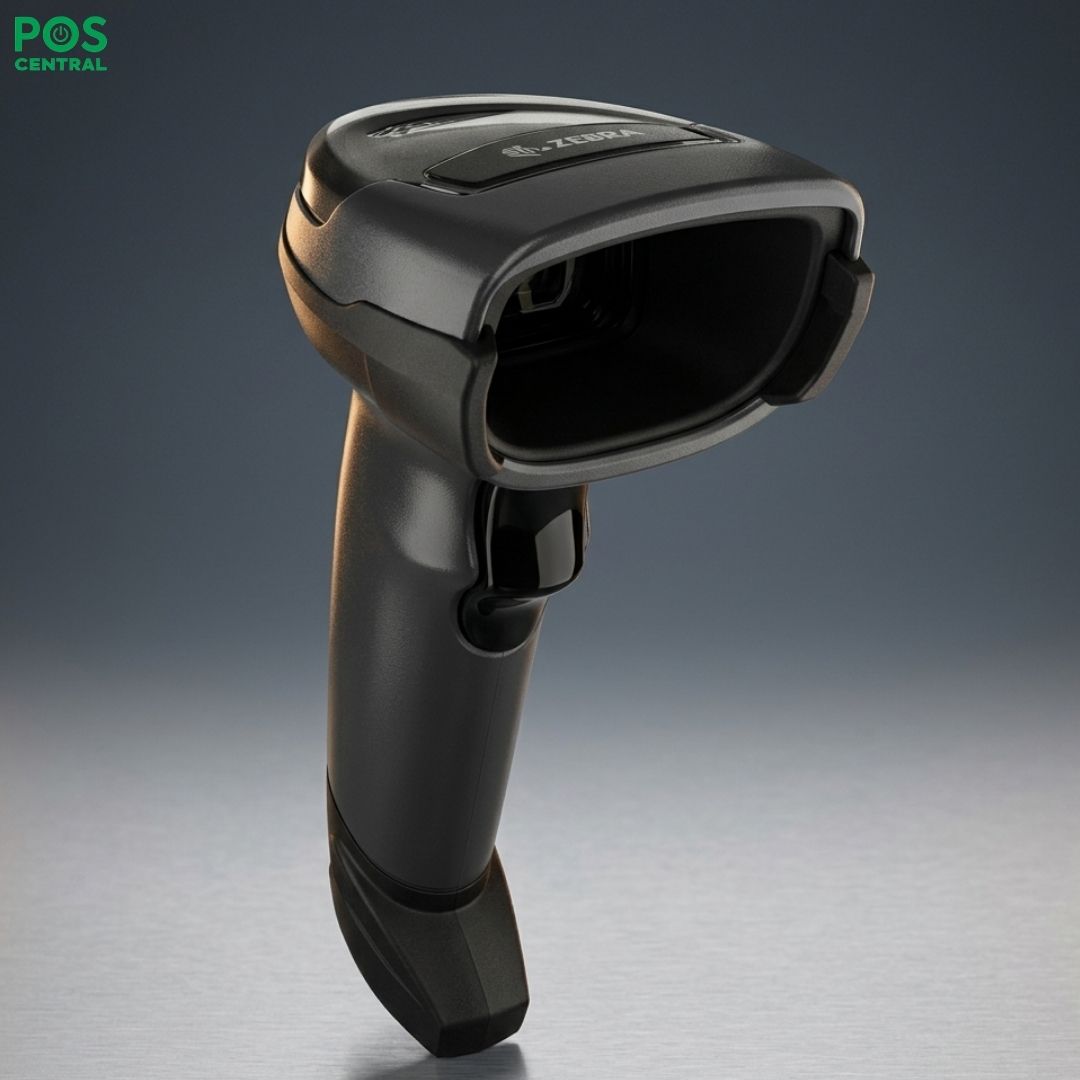
The Zebra DS4608 1D/2D Scanner (Standard Range, USB RS232, Black) is the configuration most commonly deployed in UK retail and healthcare POS environments. Key specifications:
- Scan engine: Area imager with omnidirectional decode capability
- Symbology support: Full 1D and 2D: EAN, UPC, Code 128, Code 39, QR Code, Data Matrix, PDF417, Aztec, Composite, GS1 DataBar, and more
- Interface: USB (HID keyboard, CDC serial) and RS232 — selectable via cable
- Optimal read range: Approximately 3 to 15 inches (standard range configuration)
- Drop specification: 1.5 metres onto concrete
- Ingress protection: IP52 (dust and low-pressure water resistant)
- Colour: Black
- Management: Zebra DNA suite — remote configuration, firmware updates, health monitoring
- Form factor: Corded handheld; stand-capable without additional accessory
Who Benefits Most from the Zebra DS4608?
The DS4608 Scanner is not a universal answer to every scanning challenge, but it covers the majority of commercial use cases exceptionally well. The following environments gain the most from its capabilities.
Mid-to-Large Retail Chains
Businesses operating ten or more POS lanes across multiple locations benefit enormously from the Zebra DNA management platform. Centralised configuration ensures every scanner in the estate behaves identically — critical for consistent loyalty programme handling, age-verification workflows, and promotional barcode acceptance.
Pharmacies and Healthcare Dispensaries
GS1 compliance is increasingly mandatory in pharmaceutical supply chains. The Zebra DS4608 Barcode Scanner reads GS1 DataMatrix codes reliably at dispensing counters, supporting track-and-trace requirements without specialist hardware.
Hospitality Venues with Digital Ticketing
Theatres, stadiums, and event venues scanning mobile tickets on phones benefit from the DS4608's ability to decode QR and Aztec codes from illuminated screens — conditions that can defeat lower-quality imagers.
Businesses Upgrading from Legacy POS Infrastructure
The Zebra DS4608 Barcode Scanner USB RS232 dual-interface design makes it the practical choice for any business mid-transition between older RS232-based POS systems and modern USB terminals. It connects to both without compromise, eliminating the need to time-coordinate scanner and terminal upgrades.
Five Questions to Ask Before Buying a POS Barcode Scanner
Choosing a scanner for a commercial POS environment involves more than comparing read speeds on a spec sheet. These five questions cut through the noise:
- Do you need 2D decode capability today — or will you within three years?
If digital coupons, QR loyalty cards, or pharmaceutical compliance are part of your operation now or on the roadmap, a 1D-only scanner is a short-term saving with a medium-term replacement cost. The DS4608 Scanner answers both.
- What interfaces do your terminals use?
Mixed USB and RS232 environments require dual-interface hardware. The Zebra DS4608 Barcode Scanner USB RS232 variant covers both without additional adapters.
- How many locations and lanes are in scope?
Single-site, single-lane operations may not leverage Zebra DNA's remote management capability fully. Multi-site deployments will find it invaluable.
- What is the realistic drop and environmental risk?
High-traffic retail and healthcare environments justify IP-rated, drop-tested hardware. The DS4608's 1.5m drop specification and IP52 rating are meaningful in these contexts.
- What is the total cost of ownership, not just the unit price?
A scanner that fails in 18 months or requires specialist configuration support on-site costs more than a higher-quality device purchased for a modest premium. Enterprise Zebra devices are designed for multi-year deployment cycles.
Sourcing the DS4608 Through a POS Specialist
Hardware procurement decisions carry less risk when made through a specialist reseller that understands how individual components fit within a wider POS ecosystem. POS Central stocks the Zebra DS4608 alongside compatible receipt printers, cash drawers, and terminal hardware, and can advise on interface compatibility for common retail software platforms. For organisations deploying across multiple lanes or sites, consolidating procurement through a single specialist channel simplifies both logistics and post-sale support.
The Takeaway: A Scanner That Keeps Pace with Retail Evolution
Barcode scanning technology has not stood still, and neither have the demands placed on POS hardware. The Zebra DS4608 represents the current standard for what a counter-based scanner should deliver: omnidirectional 1D/2D imaging, dual USB and RS232 connectivity, enterprise-grade durability, and centralised management — packaged in a device designed for daily commercial use. For businesses still running single-interface 1D scanners, the question is not whether an upgrade will eventually be necessary — it is how long the delay will cost in misread barcodes, incompatible loyalty integrations, and replacement hardware cycles.
Read more:
